Industrial control has been deaf, mute, and amnesiac for fifty years.
The body that fixes that is built and running. Here is what it does today —
and what it becomes once it wakes up.
Part I — measured against a live instance ·
Part II — forward-looking · figures read from v1.0.1058, 2026-06-21
How to read this. It is built in two halves with a hard wall between them.
Part I is sober — every capability and number is measured against a live, licensed
instance and reproducible by anyone with the binary. Part II is forward-looking,
and says so plainly. The wall is deliberate: a vision is only worth reading if you can
trust the ground it stands on. Nothing in Part I is aspirational. Everything in Part I runs today.
The Thesis
Every machine in your plant is deaf, mute, and amnesiac.
It cannot see the part it is making. It cannot tell the technician what just went wrong.
It remembers nothing from one shift to the next. This is not a failure of any one vendor —
it is the settled state of an entire industry, and it has held for over fifty years.
We decided it was a bug, not a law of nature.
The control loop — the deterministic scan that reads inputs, runs logic, and drives outputs,
thousands of times a second — is the most trustworthy piece of software in the industrial
world. It is also the dumbest. For half a century that trade was correct: determinism near
moving steel is sacred, and nobody dared put a system that guesses anywhere near a
press, a pour, or a person.
Meanwhile, machine intelligence finally grew hands and eyes. It can perceive, reason,
explain, and write. But it grew up in the wrong place — in the cloud, a network round-trip
and a non-deterministic inference away from the machine. You cannot put it inside the scan.
The loop will not wait 300 milliseconds for an answer that might be wrong.
So the field is stuck on a false choice: a body with no mind, or a mind with no body.
ControlForge dissolves the choice. It is a real, standards-compliant PLC
runtime — deterministic, auditable, a single self-contained binary — built from the start to
let cognition live beside the scan instead of across a network from it. The reflex
stays sacred and untouched. Around it, the runtime grows the rest of a nervous system:
reflex (the deterministic IEC 61131-3 scan), nerves
(thirteen wire-proven industrial protocols), senses (perception primitives
already callable from control code), and cognition (an embedded AI assistant
and an open agent control plane).
We did not bolt a brain onto a machine. We gave the loop a place where a mind can live.
Part I
The Machine That Runs Today
Sober. Every claim below is measured and reproducible.
1.The Forty-Year Freeze
The programmable logic controller was born in 1968 to replace banks of electromechanical
relays. Its core architecture — scan inputs, solve logic, write outputs, repeat on a fixed
cycle — was right then and is right now. The determinism is not an accident; it is the whole
point. But the very properties that make the loop trustworthy also froze it. Three walls went
up and never came down:
The determinism wall. A control decision must happen on time, every time.
Anything that might take longer this scan than last — a garbage collector, a network
call, a model that thinks for a variable number of milliseconds — is disqualified by
construction. So the loop stayed simple.
The IT/OT wall. The smart software lives in IT, on the other side of an air
gap, talking to the machine through a thin straw of tags sampled once a second. It can watch
the machine. It cannot be the machine.
The amnesia wall. A classic PLC has no memory of yesterday and no awareness
of the plant next door. Knowledge that should compound — every fault, every recipe, every
hard-won tuning — evaporates at the end of the scan.
None of this was a mistake. It was a rational response to genuinely high stakes: when the
output drives real machinery, "mostly right" is a synonym for "dangerous." The cost of that
correct choice is the plant you have today: millions of machines, every one deaf, mute, and
amnesiac — not because it had to be, but because until now there was no way to add a mind
without poisoning the reflex.
2.What ControlForge Is
ControlForge is an IEC 61131-3 PLC runtime written in Go. Before it is anything
visionary, it is a correct PLC — and that ordering is the entire architectural thesis.
It is one binary. A single, statically-linked, cgo-free
executable with no runtime dependencies. It drops onto a server, an industrial PC, or a
single-board computer and runs. One file you can hash, sign, audit, and deploy.
It is deterministic. Programs are written in Structured Text and executed on
fixed-period tasks with real priorities and scan times. The control core does the classic thing
the classic way, on time, every time.
It is standards-real. Not a simulator and not a subset that breaks on contact
with the field. The AI, the perception, and the connectivity were added around the
deterministic core without compromising it. Everything intelligent the runtime does, it does
beside the scan — never inside it, slowing it down, and never across a network, starving it.
That is the design constraint the cloud-AI approach cannot satisfy and the single-binary
edge-native approach can.
3.The Capability Surface
The measured ledger, read from the live registry of a licensed v1.0.1058 instance on 2026-06-21.
2,361built-in ST functions live registry
13wire-proven industrial protocols
85–103×speedup on heavy floating-point kernels
1cgo-free binary zero runtime deps
12standard IEC function blocks
VISION+VIDEOperception primitives in the scan
The nerves — thirteen wire-proven protocols
ControlForge speaks, on both client and server sides where the protocol defines them, and
from both ST code and configuration. This is depth, not a checklist — counting only the
functions exposed to control code:
Modbus 84SEL 59BACnet 58S7 56SNMP 48NATS 44EtherNet/IP 43MQTT 42OPC UA 36OPC UA PubSub 13FINS 31IEC 60870-5-104 27DNP3 25DF1 24Sparkplug BInfluxDB
"Wire-proven" means tested against real protocol stacks in a loopback harness, not asserted
from a datasheet.
The senses — perception in the control language
This is the part that does not exist in a classic PLC at all. The runtime exposes vision and
video primitives directly to control code: VISION_* triggers inference and
reads object counts, labels, confidences, and per-object fields, with inference timing as a
first-class value; VIDEO_CAMERA_* creates, configures, and captures from live
cameras inside the runtime. A control program can ask what do you see and branch on
the answer — on the machine, in the loop. The eye is already wired to the reflex.
The data spine, the memory, and the mind
Northbound by design — MQTT, Sparkplug B, and NATS carry machine state
up; an embedded historian and tag-freshness primitives (VAR_TS,
VAR_AGE_MS) mean the runtime knows not just a value but how old it is
— the first crack in the amnesia wall. An embedded AI assistant runs inside
the runtime — reading the project, drafting and validating Structured Text, answering questions
about the live machine, with no external service in the loop. And an open agent control
plane exposes the runtime's full operation — programs, tasks, variables, diagnostics,
protocols — over a standard agent-interface protocol, so an AI agent can operate the
PLC the same way a human engineer does. This is not a future integration; it is how the runtime
is administered today.
4.Proof, Not Promises
A vision document earns the right to dream in its second half by proving, in its first, that
the team behind it does not ship vapor. Three standing disciplines make Part I trustworthy —
and they are themselves part of what ControlForge is.
Every regression becomes a permanent sentinel. When something breaks, a check
that re-detects that entire class of failure — forever — is added to an automated overseer that
probes live instances and regenerates a status board on every run. Bugs do not get fixed twice.
No fabricated demonstrations. Numbers and behaviors shown to anyone come from
the actual running system, never a reimplementation or a mock-up. The capability ledger above
was read from a live registry for exactly this reason. If it is in this paper, it answered an
API call.
Wire-proven, not datasheet-proven. Protocol support is validated against real
protocol stacks in a loopback harness. The standard for "supported" is the device on the wire,
not a claim in a table.
▲ Everything above this line runs today — measured against a live instance.▼ Everything below is forward-looking — and always says so.
Part II
The Nervous System
Where something does not yet exist, the text says so —
and where a moonshot already has a seed running in the codebase, it names it.
Proof of Life
Before we describe the nervous system waking up, here it is twitching.
Three masses on the classic figure-eight choreography — one of the most
numerically delicate solutions in celestial mechanics — tracing their trails live. Not an
animation and not a side tool reimplementing physics for a video: a gravity solver, a
rigid-body engine, and a renderer — three heavy workloads on one shared control plane,
supervised by the runtime, stepped in lock-step with the deterministic scan. Run it twice and
you get bit-identical results.
And here is the part that matters more than the picture:
A Newton's cradle — the textbook torture test for a physics engine, because
momentum has to march cleanly down a chain of touching bodies or the illusion collapses.
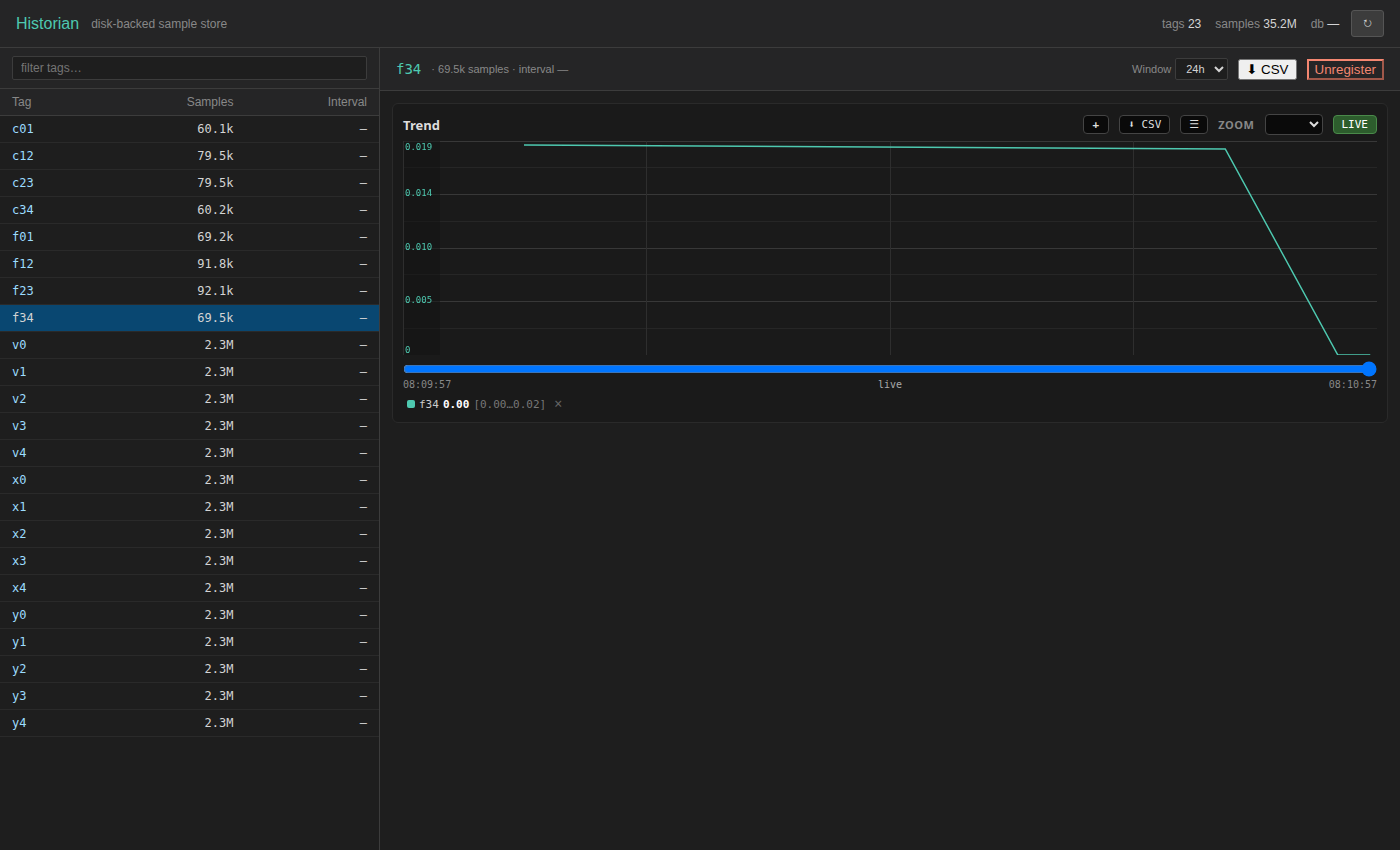
Left: it runs as a digital twin. Right: every physical quantity it produces
— contact forces, per-ball velocities and positions — is a live PLC tag in the
runtime's own historian: 23 tags, 35.2 million samples, disk-backed, with the
f34 contact force trending. The cradle is not a video of a simulation. Its
physics are data flowing through the same runtime that drives real machines.
Modeling the world is the easy half. Here is the runtime's embedded AI controlling it —
the inverted pendulum, the problem no traditional PLC can touch.
An inverted pendulum — the canonical unstable-control benchmark; left to itself
it topples in a second, and a plain PID flails at it. Here the runtime's embedded AI did the whole
job by itself: it queried the compute brain, derived the cart-pole model, designed an
optimal LQR controller, wrote the Structured Text, baked the gains into a frozen
runtime parameter, and closed the loop — catching the pole and holding it dead-vertical
(θ → 0.0°) with control effort decaying to zero. The control was designed
off-scan and frozen; the deterministic 100 Hz scan only executes it. Rendered from
the actual Rapier poses — not a reimplementation.Then it was asked to show off — and it upgraded its own controller. It converted
the balance law into LQR setpoint tracking and authored a looping routine that drives the
cart back and forth off-center (±0.5 m) through two sudden stops — the abrupt
decelerations that try hardest to throw the pole. Through the entire routine the pole never tips
past 2.7°. The engineer who wrote this control code is the machine.
Four demonstrations, all already real, all captured from the actual system — and an escalation:
the runtime can host a faithful, deterministic model of the physical world beside the scan,
treat it as first-class control data, and then let the intelligence inside the machine
design the control for it. A world model, and an AI that controls it, both living
in the PLC. Hold that thought. Every section below is a consequence of it.
5.AI at the Edge Needs a Body
The prevailing bet on industrial AI is a disembodied one: keep the intelligence in the cloud,
let it sip tag data through the historian, and send advice back down. It is a reasonable bet,
and it is wrong about the most important loops. Advice that arrives a network round-trip late,
with no guarantee of arriving at all, cannot own a control decision. The cloud can counsel
the machine. It cannot be the machine.
A mind that acts on the physical world needs a body with three properties the cloud cannot
offer: it must be local, so the loop never waits on a network; it must be
deterministic, so the reflex underneath the cognition is never poisoned; and it
must be auditable, so that when an intelligence touches metal, a human can see
exactly what it did and why. ControlForge is built to be that body.
6.The Self-Explaining Machine
Picture the technician at 2 a.m., alone, with a line down and a plant
manager already calling. Today the machine offers a fault code and a stack of manuals.
Tomorrow the machine explains itself — in plain language, on the panel, offline: "I stopped
because infeed pressure fell below the interlock for the third time in an hour. Each time it
followed a dropout on the upstream conveyor's network segment. Here is the trend. The conveyor,
not me, is the thing to look at." Not a chatbot bolted to a dashboard — a machine that
understands its own state and history well enough to narrate them.
7.The Self-Writing Plant
Control logic is still written the way it was in 1990: by hand, by a specialist, one statement
at a time. Tomorrow, the engineer describes intent — "interlock the press until both
light curtains are clear and the part is seated" — and the machine drafts the Structured Text,
checks it against the runtime's own rules, simulates it against a twin, and hands back logic
that is correct before it is ever downloaded. The specialist moves from typing to judging.
8.The Perceiving Plant
A blind machine cannot inspect the part it just made. Today, vision lives in a separate box
from a separate vendor, integrated through a fragile handshake, its verdict arriving as a single
bit. Tomorrow, perception is simply part of the control program: the loop asks what do you
see and branches on the answer — counts the parts, reads the label, judges the weld,
rejects the defect — in the same scan, in the same language, as the logic that drives the
actuator.
9.The Learning Fleet
A classic plant is an amnesiac archipelago: every controller an island, every shift a fresh
start, every hard-won bit of tuning lost when the power cycles. The fleet that learns is the
opposite. Before bad logic touches real steel, it is tried against a faithful twin and its
consequences are seen, reproducibly. Good logic, once found on one line, propagates to
every identical line. Tuning discovered in one plant raises the floor for all of them. Knowledge
stops evaporating and starts compounding.
10.The Negotiating Plant
The last wall is between machines. Today they are wired together by a human who decides, in
advance, exactly how the conveyor hands off to the press. Tomorrow, machines that each understand
their own state and goals negotiate the handoff themselves — the upstream cell tells the
downstream cell what is coming and when, the downstream cell answers with what it can take, and
the line balances itself without a central choreographer scripting every move.
Where This Goes
Read the two halves of this paper together and the shape is clear. Part I is a body that
already exists: deterministic, connected, sensing, single-binary, trustworthy near metal.
Part II is that body waking up — explaining itself, writing itself, perceiving, learning across
a fleet, and eventually negotiating with its peers. None of the second half requires abandoning
the first. Every moonshot is a consequence of the same architectural choice —
let cognition live beside the scan, not across a network from it — and every one of
them already has a seed running in the codebase, several of which you can watch execute on this
very page.
The machines on the floor have been deaf, mute, and amnesiac for fifty years. The
body that fixes that is built and running. What remains is to wake it up.